
The First 30 Days of a Campaign Nobody Sees
Campaign Planning Kenya often looks like nothing is happening. There is a strange period in every serious campaign when, from the outside, almost nothing appears to be happening. There are no posters competing for attention, no crowded rallies and perhaps very little for the public to photograph or discuss.
Yet inside the campaign, this can be one of the most consequential periods of all. People are listening, assumptions are being tested, relationships are being mapped and the team is beginning to discover whether the strategy that looked convincing in a meeting can survive contact with reality.
This is the part of campaigning that rarely becomes visible because it does not produce spectacular images. But visibility is not the same thing as progress. Before a campaign can persuade anyone, it has to understand what it is trying to change, whose behaviour it needs to influence and what stands between the current reality and the desired one. The first thirty days are therefore not simply preparation for the campaign. They are the beginning of the campaign’s learning system.
A Campaign Has a Problem Before It Has a Message
One of the most persistent mistakes in campaign planning is starting with communication. The temptation is understandable. Once there is a message, there is something to design, distribute, photograph and measure. The organisation begins to feel as though it is moving.
But a message is an answer to a problem. If the problem has not been properly understood, communication can become an exercise in making an assumption more visible.
The more useful questions are uncomfortable ones. What does the audience currently believe? What would have to change for behaviour to change? Which concerns are genuinely important and which ones have simply become prominent inside the campaign office? Who influences the people the campaign needs to reach? Which communities require a different approach? What does the campaign believe to be true that it has not actually tested?
This is where strategy begins to separate itself from activity.
The first thirty days should therefore be less about creating noise and more about reducing uncertainty.
That distinction matters because uncertainty is expensive. A campaign that discovers an important weakness early can change direction quietly. A campaign that discovers the same weakness after months of public communication has to change while explaining why it was wrong in the first place.
People Do Not Live Inside Segments
A campaign can produce an impressive audience map and still misunderstand its audience.
People are not demographic categories walking around waiting to be reached. They exist within networks of relationships that influence what they hear, what they believe and whose opinion they trust.
A person may belong to a particular age group, occupation and geographical area, yet respond to a message because of a conversation with a colleague, a family member, a community organiser or someone they have trusted for years. The person who influences a decision at work may be different from the person who influences it at home.
This is why a sophisticated campaign asks a question that is often more useful than simply asking who the audience is. Who does the audience listen to?
Research on political mobilisation has demonstrated the importance of social networks and interpersonal relationships in influencing participation.[1] Research into African campaign strategy has similarly shown how mobilisation approaches vary according to local political conditions and the constituencies being addressed.[2]
For the strategist, the implication is significant. The unit of analysis cannot always be the individual. Sometimes it is the relationship between individuals. And sometimes the most valuable person in a campaign is not the person with the largest following, but the person whose opinion travels through a network that matters.
The First Test Should Be the Strategy Itself
A serious campaign should be prepared to discover that its first strategic idea is wrong.
This is difficult because strategies quickly acquire institutional weight. Once an idea has been approved, presented and translated into creative work, talking points and activity plans, questioning it can begin to feel like resistance rather than strategy.
The first thirty days should create permission to do exactly that. Does the message make sense outside the strategy room? Can an ordinary person explain what the campaign is actually saying? Does the proposition connect with something people consider important? Does the strategy still make sense when viewed from the perspective of the people it is supposed to influence?
These are not cosmetic questions. They determine whether the campaign has a communication problem, a positioning problem or a strategy problem, and there is an important difference between the three.
A communication problem may require better expression. A positioning problem may require a different way of framing the proposition. A strategy problem may require the organisation to rethink what it is trying to achieve.
A new poster cannot repair a weak proposition. A stronger slogan cannot compensate for poor understanding of the audience. More media cannot automatically solve a strategic mistake.
The Field Is Where Assumptions Meet Reality
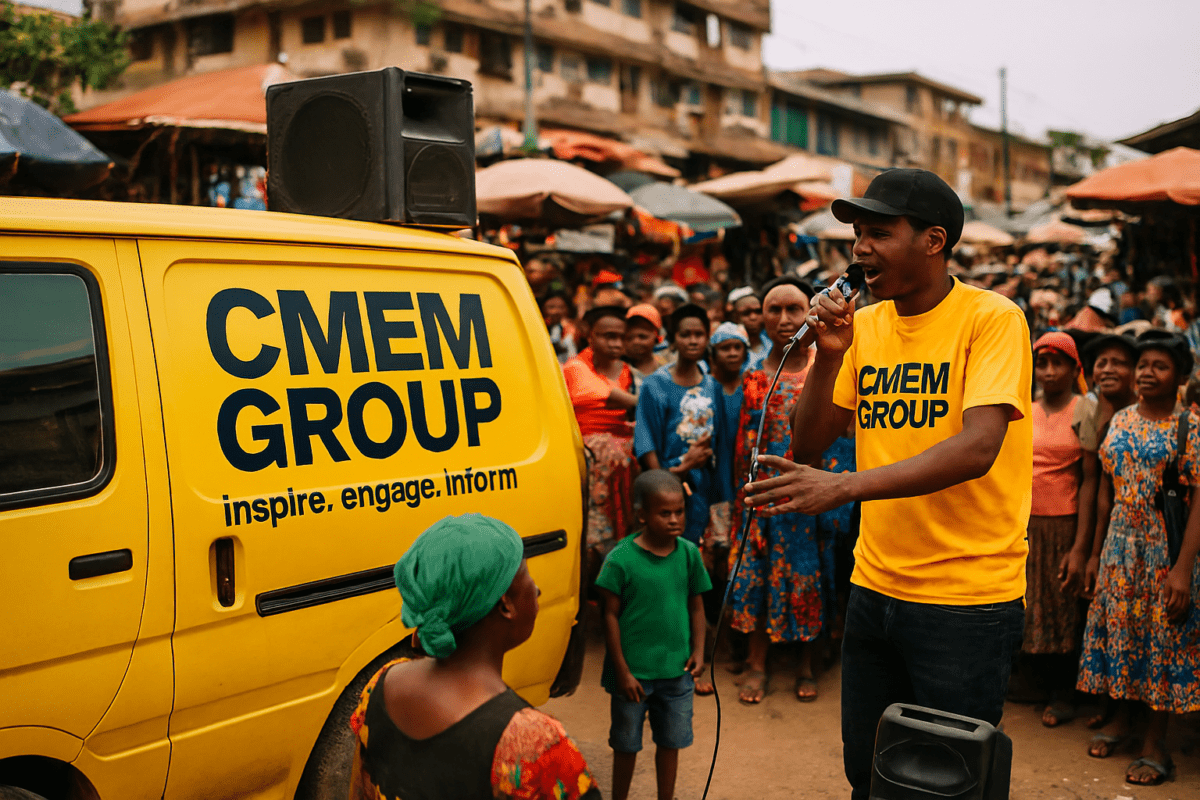
There is a point at which no presentation, dashboard or research document can substitute for proximity to the people a campaign is trying to understand.
This is where the field becomes valuable. Not because the field is somehow more truthful than data, but because it provides context that data alone may not capture. A digital conversation can reveal what people are discussing. A survey can reveal attitudes. A conversation in a community can reveal why those attitudes exist and how they are expressed in ordinary language.
A concern that appears dominant nationally may be less important in a particular community. A message that performs well online may sound irrelevant in a face to face conversation. A group that appears difficult to reach through conventional media may already have a strong network through which information travels naturally.
The answer is not to choose between data and field intelligence. The answer is to create a feedback loop between them.
Observe. Form a hypothesis. Test it. Listen to the response. Adjust.
That is a very different organisational culture from deciding the strategy in advance and spending the rest of the campaign trying to prove that the original decision was correct.
A Message Is Not Finished When It Leaves the Strategy Room
There is a useful test that rarely appears in campaign presentations. Take the message out of the presentation and place it inside an ordinary conversation.
Can someone remember it? Can they explain it without repeating the exact words of the campaign? Can they connect it to their own experience? Can they explain why it matters to another person?
A message that only works when delivered by a trained spokesperson is dependent on the organisation for its distribution. A message that people understand well enough to explain in their own words has the potential to travel through relationships.
Research into political volunteering and digital mobilisation has also shown that digital communication can support participation while interacting with the social relationships and motivations that make mobilisation possible.[3]
The lesson is particularly relevant in an environment where digital and physical communication increasingly overlap. A campaign may begin online, be discussed in a WhatsApp group, be interpreted during a conversation at work and eventually become part of a face to face community discussion.
The channel changes. The human relationship remains.
When Reality Interrupts the Plan
At some point, reality will disagree with the strategy. A local issue will become more important than expected. A message will produce an unexpected reaction. A competitor will change the conversation.
The instinct may be to describe these events as disruptions. A sophisticated strategist may see them differently. They may be signals.
Not every signal deserves a strategic response. If a campaign changes direction every time someone reacts unexpectedly, it has confused responsiveness with strategy. But significant reactions deserve investigation.
The question is not simply, “How do we stop this?” It is, “What has this revealed that we did not know before?”
That question turns unexpected events from threats into sources of intelligence. And that may be one of the most important capabilities a campaign can develop: the ability to learn faster than the environment changes.
The Marketing Lesson
Brands go through remarkably similar periods, even though they call them different things.
Before an activation, there is audience mapping. Before a roadshow, there is location and consumer analysis. Before a product launch, there is research and proposition development. Yet marketing organisations often feel pressure to move quickly towards visible activity.
The banners arrive. The promoters are deployed. The content goes live. The event happens. The dashboard begins producing numbers. And suddenly the organisation has something to report.
But activity can create the illusion of progress. A roadshow can reach thousands of people without producing meaningful behavioural change. A supermarket activation can attract attention while failing to convert attention into purchase.
The question, therefore, is not whether the campaign was visible. It is whether the activity was built on an understanding of what needed to change.
The work nobody sees can determine the value of everything people eventually see.
What Happens Before the Campaign Becomes Visible Matters
By the time the posters go up, the public campaign may look complete. It is not.
The visible campaign is simply the point at which a long series of invisible decisions becomes public. The research. The conversations. The mapping. The testing. The disagreements. The revisions. The decision about where to show up. The decision about who needs to carry the message.
Eventually, all of those decisions become visible through one thing. Execution.
That is why the first thirty days should not be judged by how much noise the campaign has created. They should be judged by how much uncertainty it has removed.
The campaign nobody sees is already doing something important. It is deciding what the campaign everyone sees will become.
Sources Referenced
- Research on political mobilisation, social networks and interpersonal influence on participation. Source citation to be confirmed and linked before publishing.
- Research into African campaign strategy and how mobilisation approaches vary by local political conditions and constituency. Source citation to be confirmed and linked before publishing.
- Research into political volunteering and digital mobilisation, and its interaction with social relationships and motivation. Source citation to be confirmed and linked before publishing.
The work nobody sees is the work that decides everything people eventually see.
CMEM Group spends the first thirty days doing the unglamorous work, mapping audiences, testing assumptions and building the intelligence that makes every campaign across Kenya and East Africa actually land.
Talk to Our Strategy Team →
 Centro Insights