

The Local Advantage: Why Understanding East Africa May Matter More Than Reaching East Africa
Local Brand Relevance East Africa is not about putting a familiar face on a global campaign. There is a lesson hidden in the brands East Africans buy every day, and it is not necessarily that consumers prefer local brands. It is something more complicated, and perhaps more important for marketers to understand.
Consumers often reward brands that fit the reality of their lives. They reward products they can find, afford, understand, trust and use. They reward brands that show up in the places where shopping actually happens and in ways that make sense within the environments in which people live.
That distinction matters, because a brand can be proudly East African and still feel completely disconnected from the East African consumer. It can use local faces in advertising, speak in familiar language, celebrate local culture and run a campaign filled with recognisable imagery, yet still fail to understand the customer standing in front of the shelf. It can have national distribution on paper and still be difficult to find in the places where a particular customer actually shops.
Local relevance is therefore not simply about putting a local face on a regional campaign. It is about understanding the market well enough to make the brand useful within it.
A Kenyan Number With a Regional Lesson
New data from Worldpanel by Numerator’s Brand Footprint 2026 provides an interesting starting point. The research reports that local and regional brands account for 80% of Kenya’s Top 30 most chosen FMCG brands. It also reports that consumer spending in FMCG increased by 17.9% in 2025, while the number of households buying FMCG products increased by 2.9%.[1]
There is an important point here that goes beyond the ranking itself. The data does not suggest that local brands succeed simply because they are local. Worldpanel’s own interpretation points towards familiarity, accessibility and relevance, while its analysis of the wider Top 250 shows that household penetration and purchase frequency remain important growth levers.
That is a much more useful lesson for marketers than simply concluding that Kenyan brands are winning. This particular data describes Kenya, and it would be a mistake to stretch it across the region as though it were a measurement of Uganda, Tanzania or Rwanda. But the underlying pattern, that closeness to the consumer converts into being chosen more often, is worth testing in every market a brand enters. The real question is this: what are brands that understand their consumers doing differently?
East Africa Is Not One Market
It is easy to say this in a strategy presentation. It is much harder to build a marketing system that behaves as though it is true. East Africa is frequently treated as one market because regional campaigns need regional numbers, but the consumer does not experience the region as a spreadsheet.
The shopping environment in South B is not identical to Pipeline. The commercial rhythm in Utawala is not the same as Kangemi. The way a customer encounters a product in Mukuru can be different from the way another encounters it in Nyeri. A shopper in Kisumu does not necessarily approach the market in exactly the same way as someone in Mombasa. Garissa, Meru, Githurai and Kibera each have their own commercial realities, retail structures, movement patterns, social influences and purchasing circumstances.
Cross the border and the differences multiply. The trading rhythm around Owino Market in Kampala is not the same as Kariakoo in Dar es Salaam. A shopper in Mwanza or Arusha is making decisions inside a different retail landscape from one in Jinja or Mbale. Kigali, with its own distinct urban structure and consumer habits, is another environment again. A regional brand promise can be identical on paper while the way it is bought, recommended and repeated changes from one of these places to the next.
This does not mean every neighbourhood or every country requires its own brand strategy. It means marketers should be careful about assuming that one regional message automatically produces one regional consumer response.
Local Is Not a Language Choice
One of the easiest mistakes in localisation is to confuse cultural decoration with consumer understanding. A campaign can use Sheng, Luganda or Swahili and still be irrelevant. It can use a popular musician and still miss the consumer. It can feature a matatu, a boda boda, a market, a football pitch or a recognisable neighbourhood and still fail to answer the question that matters most: why should this person choose the product?
Local relevance is deeper than creative treatment. It begins with the proposition itself. Does the product solve a problem people actually have? Is the price credible in the environment where the product is being sold? Is the pack size appropriate? Is the product consistently available? Does the retailer understand it?
These are not merely sales questions. They are brand questions. A brand lives in the customer’s experience of the entire system, not only in the advertisement.
The Shopkeeper May Know Something the Dashboard Does Not
There is another source of local intelligence that marketers sometimes underestimate: the person selling the product. The retailer sees things that may never appear in a monthly presentation. They hear consumers ask for products by name, they know which pack size moves faster, and they notice when a competitor introduces an offer before it ever reaches a report.
The retailer is part of the brand’s intelligence network.
This is particularly important across East Africa because informal retail remains commercially significant. GeoPoll’s 2026 FMCG study found that while supermarkets remain the leading channel overall, shops, dukas, kiosks and open markets continue to carry substantial weight, especially in fresh and staple categories. In fresh and chilled foods, GeoPoll reports supermarkets and marketplaces each accounting for 32% of reported purchasing locations across its surveyed markets.[2]
The implication is straightforward. A strategy designed around formal retail alone can miss part of the consumer’s real shopping journey, whether that journey runs through a duka in Nairobi, a kiosk in Kampala or a stall in Kariakoo. And once again, this is not simply a distribution problem. If the consumer encounters the brand differently depending on where they shop, then distribution has become part of the marketing experience.
Availability Is a Form of Communication
Marketers often think of communication as something the brand says. But availability communicates too. When a consumer repeatedly asks for a product and cannot find it, the market is receiving a message. When a competing brand is consistently available in the nearest shop while yours requires a longer trip, the consumer is receiving another message.
None of these messages may have been written by the brand manager. But consumers experience them as part of the brand. This is why the gap between marketing strategy and field execution matters so much. A beautiful campaign can create desire, but if the customer cannot complete the journey to purchase, the marketing system has broken somewhere between communication and availability.
The strongest brands therefore do not only ask, How do we make people want us? They also ask, How easy have we made it for people to choose us?
The Small Brand Has a Different Kind of Advantage
There is an interesting detail in the Worldpanel data that deserves more attention. Worldpanel reports that brands with less than 30% household penetration account for 73% of Kenya’s Top 250 brands and generate 29% of all Consumer Reach Points.[1] That suggests a market containing a large number of brands that are not yet dominant but are still capable of building significant consumer reach.
A smaller brand cannot always outspend the biggest player. But it can sometimes understand a particular consumer problem more intimately. It can listen faster, change its proposition faster and build stronger relationships with retailers in a particular market. It can become familiar in a community before it becomes famous nationally.
That is not a substitute for scale. But it is a different route towards growth, and one that large brands should not ignore.
Understanding Consumers Is Not the Same as Segmenting Them
Modern marketing has become very good at segmentation. We can divide audiences by age, income, geography, behaviour and purchasing patterns, and build dashboards that appear to tell us exactly who the consumer is.
But a segment is still an abstraction. The real consumer is a person standing somewhere, doing something, with a certain amount of money, a particular need and a limited amount of attention.
Data can tell us what happened. Observation can sometimes help us understand why. A sales report may tell us that a particular product underperformed in one location. A field team may discover that the product was placed behind a competitor, that customers misunderstood the pack, or that the retailer rarely recommended it. Those details can change the next decision.
Quality Still Matters
There is also a danger in romanticising the idea of local brands. Consumers do not owe a brand loyalty simply because it is Kenyan.
GeoPoll’s 2026 research is instructive here. Across the ten FMCG categories covered in its study, quality was the leading purchase driver for the second consecutive year, ahead of price and brand overall. The study also found that attitudes towards products made in Africa are becoming a meaningful part of the consumer conversation, with 49% of surveyed consumers saying it was very important that a product was made in Africa or in their own country, and another 18% saying it was somewhat important.[2]
These findings should not be interpreted as permission for brands to replace quality with patriotism. Quite the opposite. The opportunity is to combine local relevance with genuine product value.
Relevance gets the brand closer. Performance gives the consumer a reason to stay.
There Is a Difference Between Being Everywhere and Belonging Somewhere
Scale has obvious advantages. Being visible across the country can build familiarity. National distribution can create convenience. But scale can also create distance. The larger an organisation becomes, the easier it can be to believe that the market is understood because the organisation has more data about it.
Sometimes the opposite happens. The organisation knows more about the market in aggregate while knowing less about the individual moments in which the brand is actually chosen.
A brand can dominate national advertising and still feel absent from the consumer’s immediate world. Another brand can have a smaller footprint but become deeply familiar within a particular community because it understands the environment, the retailer and the customer better. One is scale. The other is closeness. Modern brands increasingly need to understand both.
Local relevance is the accumulated result of thousands of decisions that make a brand feel as though it understands the world in which the consumer actually lives.
What Local Relevance Should Mean for Marketers
If local relevance is treated simply as a creative exercise, it will remain superficial. If it becomes part of the operating model, it can influence where products are distributed, which retailers receive investment, how field teams are trained, and how quickly the organisation responds to what is happening in the market.
Instead of asking only, How many people can we reach?, the marketer can ask, Where are these people actually making the decision? Instead of asking only, What message should we broadcast?, the marketer can ask, What problem are we helping the consumer solve? Instead of asking only, Did the field team hit the target?, the marketer can ask, What did the field team learn that should change our next decision?
Those are different questions, and different questions tend to produce different strategies.
The Future of Local Marketing Is Not About Becoming Smaller
There is a misconception that local relevance requires brands to abandon scale. It does not. The real opportunity is to make scale more intelligent.
A national brand can still have a national identity while adapting execution to the realities of different markets. It can retain one brand promise while allowing different channels, retailers and field teams to interpret that promise according to the circumstances in which consumers encounter it.
The brand should not become a completely different brand in every town. But the experience of the brand should not feel completely detached from the people it is trying to serve.
East Africa Does Not Need More Brands Pretending to Understand East Africa
It needs brands willing to actually listen. Listen to the consumer. Listen to the retailer. Listen to the field team. Listen to what happens when the campaign leaves the boardroom. Listen to the difference between a product being visible and a product being chosen.
And then turn that listening into decisions.
Because local relevance is not a slogan. It is not a flag in an advert. It is not a piece of Sheng copy. It is not a celebrity from Nairobi standing beside a product.
Local relevance is the accumulated result of thousands of decisions that make a brand feel as though it understands the world in which the consumer actually lives.
The Local Advantage
The brands that understand East Africa will not necessarily be the brands with the biggest budgets. They will be the brands that understand that the region is not experienced from a boardroom, a media plan or a regional sales report.
It is experienced on roads, in estates, in dukas, supermarkets, kiosks, markets, shopping centres, workplaces, homes and conversations. It is experienced when a customer asks for a product and the retailer reaches for it without hesitation. It is experienced when the consumer thinks, almost without thinking, this is for people like me.
That is the real local advantage. Not simply knowing where East Africa is. Knowing how it behaves, market by market.
Strategy Should Meet the Market Where It Actually Lives
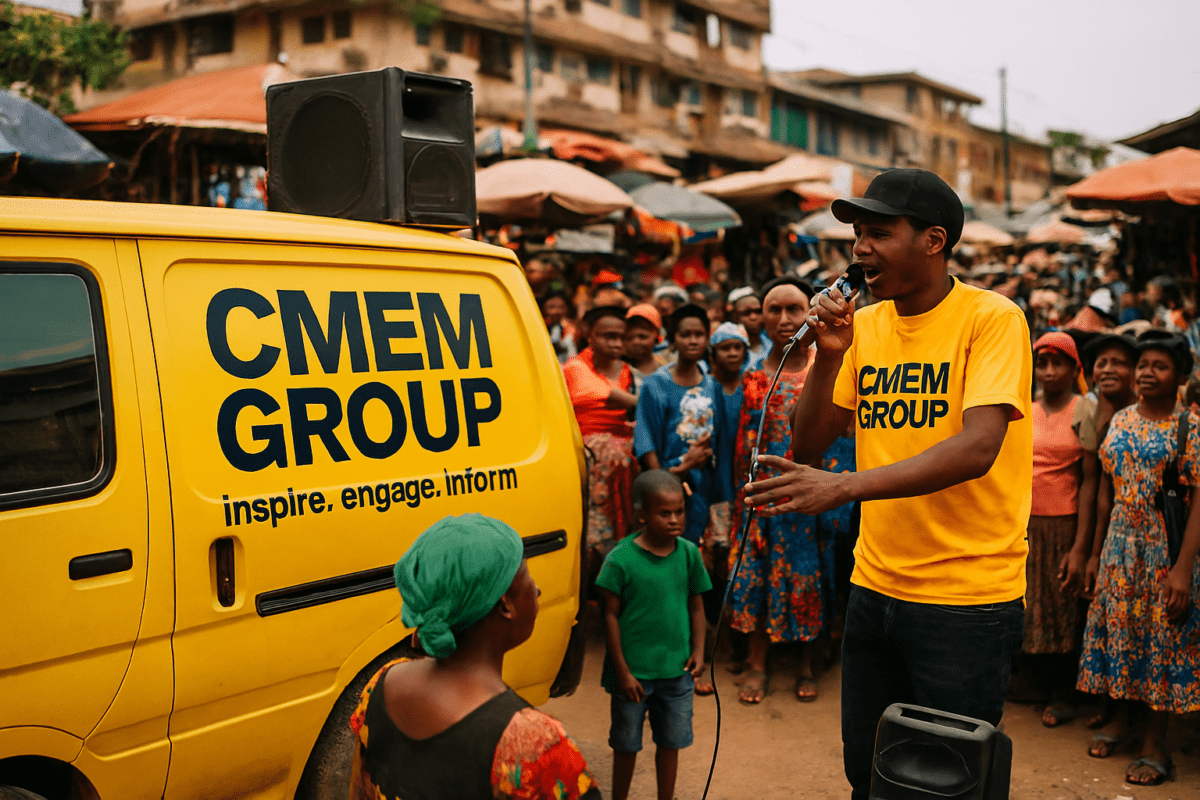
At CMEM Group, formally Centro Marketing & Events Media Group, we believe effective marketing begins much closer to the consumer than many strategies assume. That means understanding the environment in which people move, the retailers who influence decisions, the questions consumers ask, and the moments when a brand can genuinely become relevant.
Our work in field marketing, experiential marketing, merchandising, retail visibility and brand activation across Kenya, Uganda, Tanzania and Rwanda sits at that intersection between strategy and reality. The purpose is not simply to put a brand in front of people. It is to help the brand understand what happens when the strategy meets the market.
Because East Africa is not one conversation. It is millions of individual encounters, and sometimes the competitive advantage belongs to the brand that understands those encounters better.
Sources Referenced
- Worldpanel by Numerator, “Brand Footprint 2026” (Kenya FMCG rankings, household penetration and Consumer Reach Points data; figures relate to Kenya only). Source citation to be confirmed and linked before publishing.
- GeoPoll, 2026 FMCG study across ten categories (purchase channel data, purchase drivers, and attitudes towards Africa-made products). Source citation to be confirmed and linked before publishing.
Understand the Market Before You Message It
CMEM Group builds field intelligence into every campaign across Kenya, Uganda, Tanzania and Rwanda, so your brand understands the market before it tries to speak to it.

 Centro Insights