
For many brands, experiential marketing and digital marketing still sit in separate lanes. One is treated as on-ground execution, the other as performance and reporting. Yet in today’s market, this separation is increasingly where value is lost.
From our work at CMEM Group, one reality continues to surface clearly: the strongest campaigns are those where experience and digital strategy are designed to work together—from the very beginning.
- Experiential marketing creates connection.
- Digital marketing sustains momentum.
- Conversion happens when the two are intentionally aligned.
The Missed Opportunity in Many Activations
Across the market, brands are investing in activations that generate attention but fail to capture value beyond the moment. Consumers interact, sample, engage—and then walk away with no clear next step.
The issue is rarely execution. More often, it is lack of integration.
When experiential marketing is not supported by a digital pathway, brands lose the opportunity to:
- Continue the conversation after engagement
- Capture data and insights
- Retarget interested consumers
- Measure true return on investment
In a performance-driven environment, this gap is no longer sustainable.
Designing Experiences with Conversion in Mind
Experiential marketing should not end at engagement—it should lead somewhere.
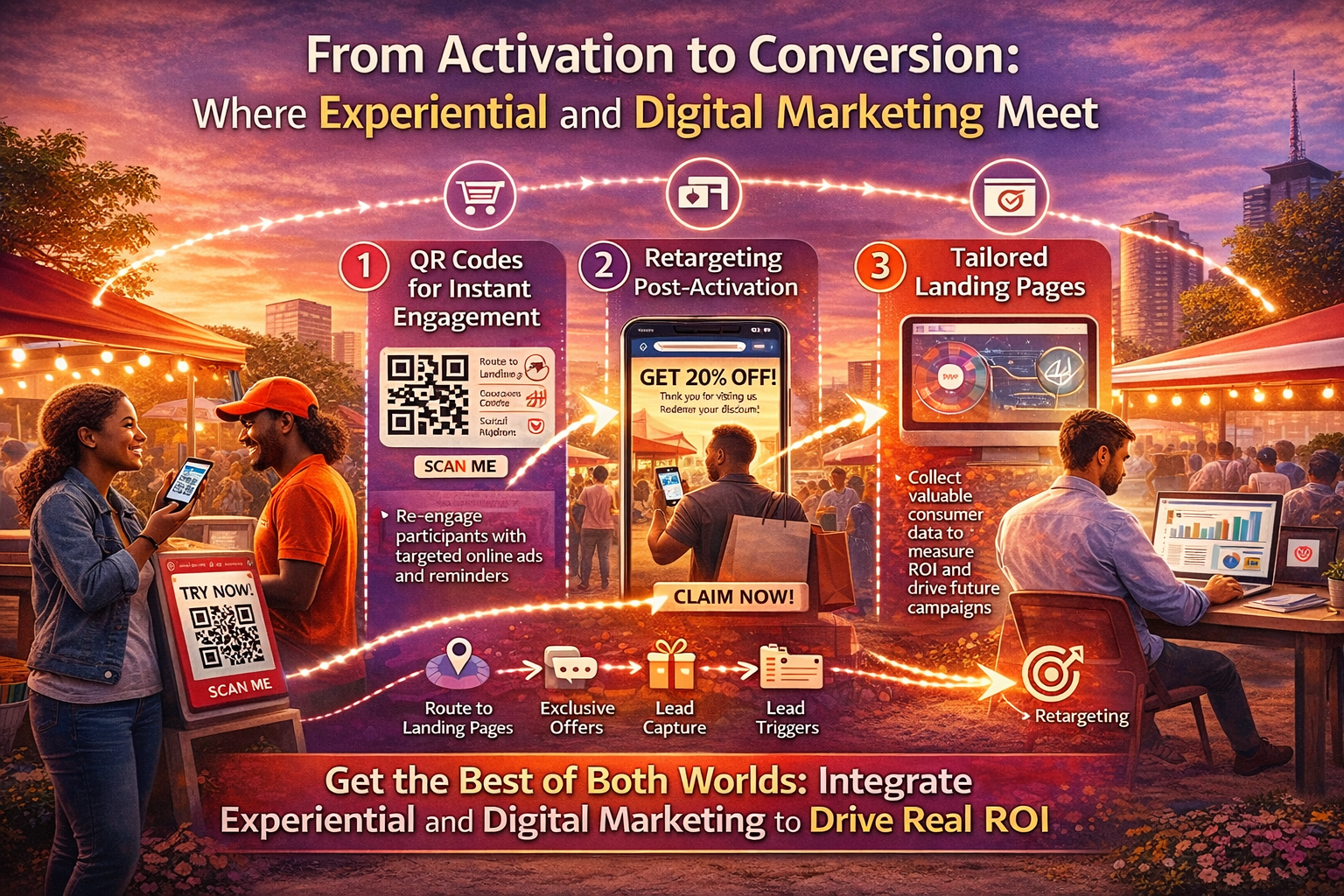
Simple digital touchpoints can transform on-ground interactions into measurable outcomes:
- QR codes that route consumers to tailored landing pages
- SMS or WhatsApp opt-ins tied to offers or product education
- Social retargeting based on physical engagement
- Location-based data capture to inform future campaigns
These are not complex tools. Their power lies in intentional design and simplicity.
When the consumer journey is clear, experience becomes a funnel—not a moment.
Why This Matters for FMCG and Retail Brands
In FMCG and retail-driven categories, decisions are fast, competitive, and highly influenced by trust. Experiential marketing builds that trust in real time. Digital marketing ensures it does not disappear once the activation ends.
Together, they enable brands to:
- Drive trial at the point of engagement
- Reinforce recall post-interaction
- Support retail conversion
- Build repeat consideration
This integrated approach aligns closely with how consumers actually behave—fluidly moving between physical and digital spaces.
Global Thinking, Local Application
In mature markets like the US and Europe, experiential and digital integration is now standard practice. Brands design experiences knowing exactly how engagement will be tracked, nurtured, and converted.
The opportunity for brands in Kenya is not to replicate global executions, but to apply the same strategic discipline locally—using simple, human, and culturally relevant touchpoints.
The Way Forward
As marketing budgets face increasing scrutiny, brands will continue to shift toward strategies that deliver clarity, accountability, and commercial impact.
Experiential marketing creates the human connection.
Digital marketing creates continuity and scale.
Conversion happens when both are treated as one system. That is where modern marketing is headed—and where brands that win are already operating.

 Centro Insights