
The Shelf is Loud. The Consumer is Selective.
FMCG retail visibility is one of the most misunderstood disciplines in modern marketing.
Walk into any supermarket today and one thing becomes immediately clear—every brand is competing for attention.
Bright packaging. Promotional tags. Branded shelves. Competing price points.
From a distance, it looks like dominance.
But from the consumer’s perspective, it feels like noise.
And in that environment, something critical happens:
The consumer doesn’t engage with everything—they filter.
The Visibility Myth in FMCG Marketing
For years, FMCG marketing strategies have prioritised visibility.
More shelf space. Wider distribution. Branded retail presence. Increased product availability.
While these remain important, they are no longer enough.
Modern consumers are:
- Overexposed to options
- Time-conscious
- Habit-driven
- Highly selective in what they notice
This creates a fundamental shift:
Visibility alone does not influence purchase decisions.
Retail Visibility vs Purchase Influence
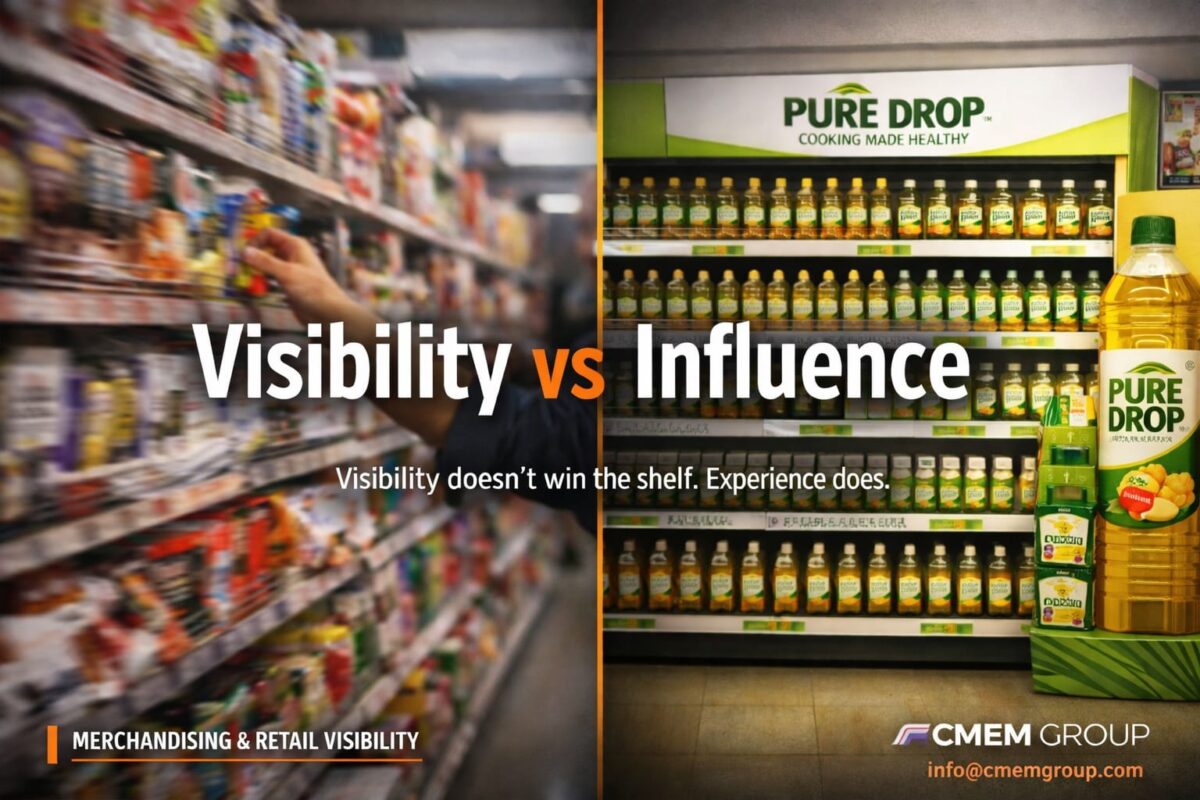
There is a clear difference between being present in-store and influencing the final decision.
Many brands achieve the first. Few master the second.
A product can be fully stocked, clearly visible, and competitively priced—and still not be chosen.
Because the moment of decision at the shelf is driven by more than visibility.
It is driven by:
- Trust
- Familiarity
- Engagement
- Experience
The 5-Second Decision Window
The most important moment in FMCG marketing is not during the campaign launch.
It is not on social media.
It is not on billboards.
It is at the shelf.
In less than five seconds, the consumer scans, filters, and decides.
In that moment, brands are not competing for attention—they are competing for selection.
Why Most Brands Lose at the Shelf
Despite heavy investment in retail visibility and merchandising, many brands still fail to convert.
And the reason is rarely the product.
It’s the experience — or the lack of it — at the exact moment the consumer is deciding.
Walk past any supermarket aisle and you’ll notice it. Shelves stocked to capacity. Branded price tags. Promotional stickers. Yet most shoppers walk straight to what they already know and pick it up without a second glance.
That’s not a visibility problem. That’s an influence problem.
Common gaps that cost brands at the shelf:
- Static displays that don’t interrupt the consumer’s routine
- Poor shelf positioning that buries the product in visual clutter
- No human engagement at the point of decision
- Inconsistent execution across different outlets and regions
The result is predictable. The brand is present — but forgettable. And the consumer defaults to habit.
What High-Performing FMCG Brands Do Differently
Brands that consistently win in retail environments take a different approach.
They move beyond visibility and focus on in-store influence.
They invest in:
- Strategic merchandising that guides the eye
- POS materials that interrupt routine
- Promoters who actively engage consumers
- Retail environments that create experience
They understand one key principle:
The shelf is not a display space. It is a decision environment.
From Visibility to Conversion
To drive real results, FMCG brands must shift their thinking.
From visibility to influence.
From presence to engagement.
From awareness to conversion.
This requires integrating merchandising, retail visibility, and in-store marketing into a single, deliberate strategy.
Because ultimately:
Sales do not happen where the brand is seen.
They happen where the consumer decides.
Final Thought
Retail has become one of the most competitive environments in modern marketing.
The brands that will win are not those that are most visible.
They are the ones that are most effective at influencing decisions in real time.
Not seen. Not remembered. But chosen.
Closing Note
At CMEM Group, we focus on merchandising, retail visibility, and in-store brand experiences that move beyond presence into measurable conversion at the point of purchase.
Because in today’s FMCG landscape:
If it doesn’t convert, it doesn’t count.

 Centro Insights